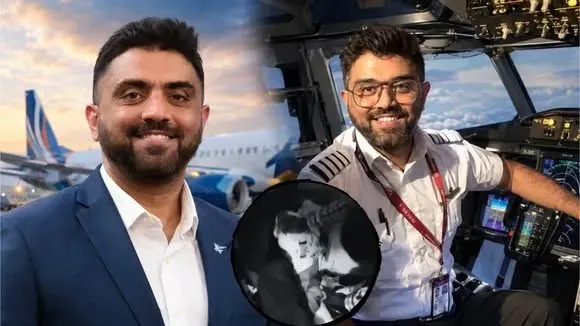
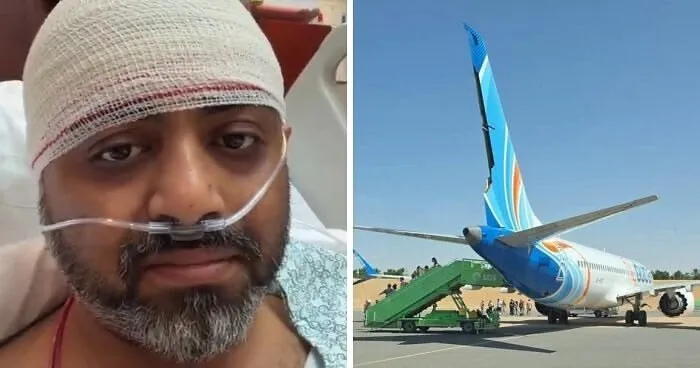
What began as an ordinary Dubai–Tel Aviv journey became a fight for survival when an Indian pilot was allegedly attacked by his own co-pilot. Seriously injured but determined to respond, Captain Smit Machchhar became part of a dramatic struggle that ended with every passenger and crew member reaching safety and later earned him international recognition. For the 174 passengers aboard Flydubai flight FZ1073, September 30, 2026, began like any other day of travel. They had boarded a flight from Dubai to Tel Aviv, expecting a routine journey. But thousands of feet above the ground, near the Jordan–Saudi Arabia border, an unexpected attack inside the cockpit turned their flight into a terrifying emergency. At the centre of the incident was Captain Smit Machchhar, an Indian pilot whose own survival became inseparable from the safety of everyone on board. According to Machchhar’s account, his co-pilot suddenly attacked him with an emergency crash axe, repeatedly striking him on the head. He sustained serious injuries to his head and hands and lost consciousness more than once. Meanwhile, the aircraft began descending rapidly, reportedly losing nearly 14,000 feet in less than 30 seconds. In those moments, the cockpit was no longer simply a workplace; it had become the scene of a struggle in which the lives of hundreds depended on what happened next. Despite his injuries, Machchhar attempted to reach the cockpit door. His efforts, along with the intervention of passengers and crew members, helped create an opportunity to restrain the accused co-pilot. Two other Flydubai pilots travelling on the same aircraft then took control. The aircraft was diverted to Tabuk, Saudi Arabia, and made an emergency landing at Prince Sultan bin Abdulaziz Airport. The outcome was significant: all 174 passengers and six crew members survived. The ordeal did not end with the landing. Machchhar was first treated in Saudi Arabia and later transferred to Zayed Military Hospital in Abu Dhabi for further medical care. As news of the incident spread, his condition and recovery drew attention in India and abroad. On October 2, Prime Minister Narendra Modi spoke to him through a video call, enquired about his health and praised his courage. During their conversation, Machchhar shared that he had recited the Hanuman Chalisa while facing the crisis. Israeli Prime Minister Benjamin Netanyahu also spoke with him and appreciated his actions. The investigation into the incident is being handled by the National Investigation Agency (NIA), which registered a case on October 9 under the Anti-Hijacking Act, 2016, and the Unlawful Activities (Prevention) Act. Investigators are examining the circumstances of the attack and whether the accused acted alone or was connected to a wider conspiracy. The case remains under investigation. Recognition followed the ordeal. On October 27, the UAE honoured Captain Smit Machchhar and fellow Flydubai crew members with the First Class Order of Zayed II. The honour was conferred by UAE President Sheikh Mohamed bin Zayed Al Nahyan, while the medals were presented by Dubai Crown Prince Sheikh Hamdan bin Mohammed bin Rashid Al Maktoum. For the passengers, the emergency landing meant returning safely to the ground. For Machchhar, it meant beginning a difficult recovery after an experience that could have ended very differently. His story is not one of a lone hero acting without help; it is a reminder of how courage, quick action and teamwork can matter when lives are at risk. Behind the uniform and the cockpit door was a human being who, even in the face of serious danger, remained part of the effort to bring everyone home.
The Pilot Who Refused to Give Up: Smit Machchhar’s Fight to Bring 174 Passengers Home
Seriously injured in an alleged mid-air attack by his co-pilot, Indian pilot Captain Smit Machchhar helped avert a tragedy aboard a Dubai–Tel Aviv flight. From an emergency landing in Saudi Arabia to conversations with two Prime Ministers and a prestigious UAE honour, his story has become one of courage under extraordinary pressure.
Photos (1)